
Appropriate Automation in Cell Therapy Manufacturing
Balancing quality, cost of goods, capital exposure, and operational resilience.

Technical Notes
Counting process hazard events to compare process design options.
Home > Process Integrity > Tallying Hazards to Compare Automation Options
17 June 2026 · 3 min read · RoteaHub Editorial
Related topics
Counting hazard events is a simple, yet surprisingly useful method for comparing alternative manufacturing strategies. It highlights non-intuitive influences and helps prioritise development initiatives.
It is an effective way to document assesments of process alterantives, how the facility is configured, and the commercial principles of the development.
The approach was originally developed to compare the quality benefits of different automation concepts during cell therapy manufacturing. Rather than attempting to predict batch failure directly, the method counts the number of opportunities for process variation to occur.
Each hazard represents an opportunity for operator error, process interruption, contamination, or variability. Reducing the frequency of these events may improve process reliability and simplify manufacturing operations.
A pre-agreed set of process hazard events are defined. For example:
Responsibility transfer – where process control is transferred between operators, equipment, or external activities such as QC testing.
Operator prompt – where an operator must attend the process, for example:
Data input - where information has to be captured, recorded or applied to the process where a data error can occur.
The number of times each event type occurs in the planned process is then simply counted.
The hazard list is ideally developed through direct observation of manufacturing activities, tallying events as they occur during execution. Batch records and manufacturing specifications can also provide useful starting points for analysis.
Alternative designs can then be explored by:
Review the hazard tally for each design. This creates the need for sufficient detail in the design concept to have visibility of the hazards. Once that has been created, the revised tally can be created from the incremental process changes.
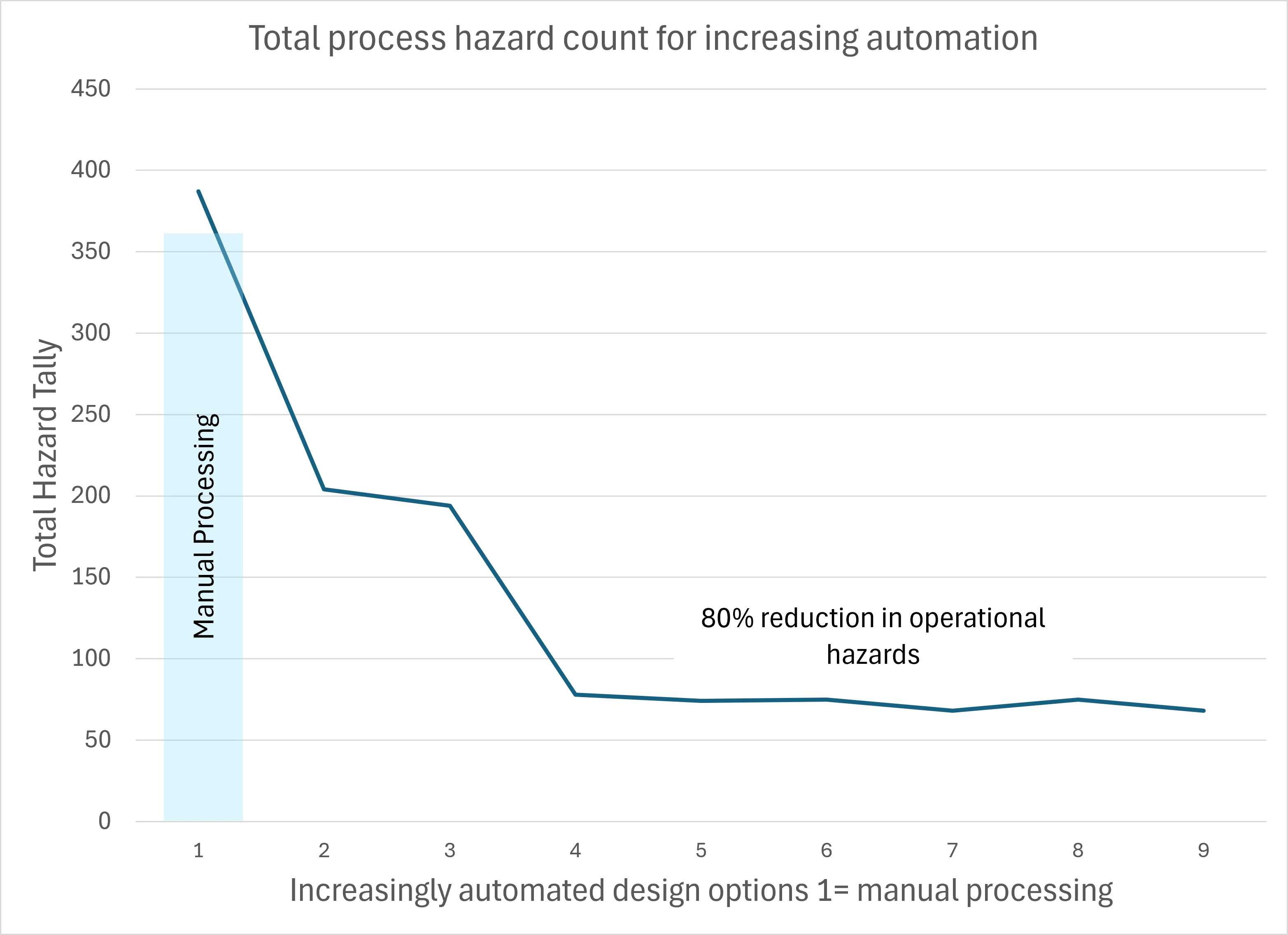
By way of example, the conclusions for two operational days of a multi-day process are displayed here.
In this example, configurations 1 and 2 are incremental refinements of the existing manual process. Configurations 3 and beyond are progressively more integrated processes automated inside functionally closed kits.
The resulting hazard tallies often reveal an important insight: the largest reductions in operational hazards are typically achieved during the early stages of automation, particularly when manual manipulations are replaced by functionally closed workflows. Further automation may continue to provide benefits, but often with diminishing returns.
Hazard tallying is a simple but powerful tool for comparing manufacturing strategies. By counting opportunities for process variation, it becomes possible to identify design priorities, evaluate automation concepts, and support risk-based manufacturing decisions.
While hazard counts do not directly predict batch outcomes, they provide a practical measure of relative process complexity and reliability. In many cases, the analysis reveals that the greatest benefits arise not from maximum automation, but from appropriate automation.
We've sent a 6-digit verification code to your email. Please enter it below.