
Rotea Protocol Review Tool
Explore your protocols using the free trial software

Rotea Process Insights
Managing Patient Variability in Rotea Processing
4 July 2026 · 6 min read · RoteaHub Editorial
Related topics
A Rotea protocol designed to process patient product needs to compensate for likely changes in:
collection volume, total cell count, target cell concentration and haematocrit.
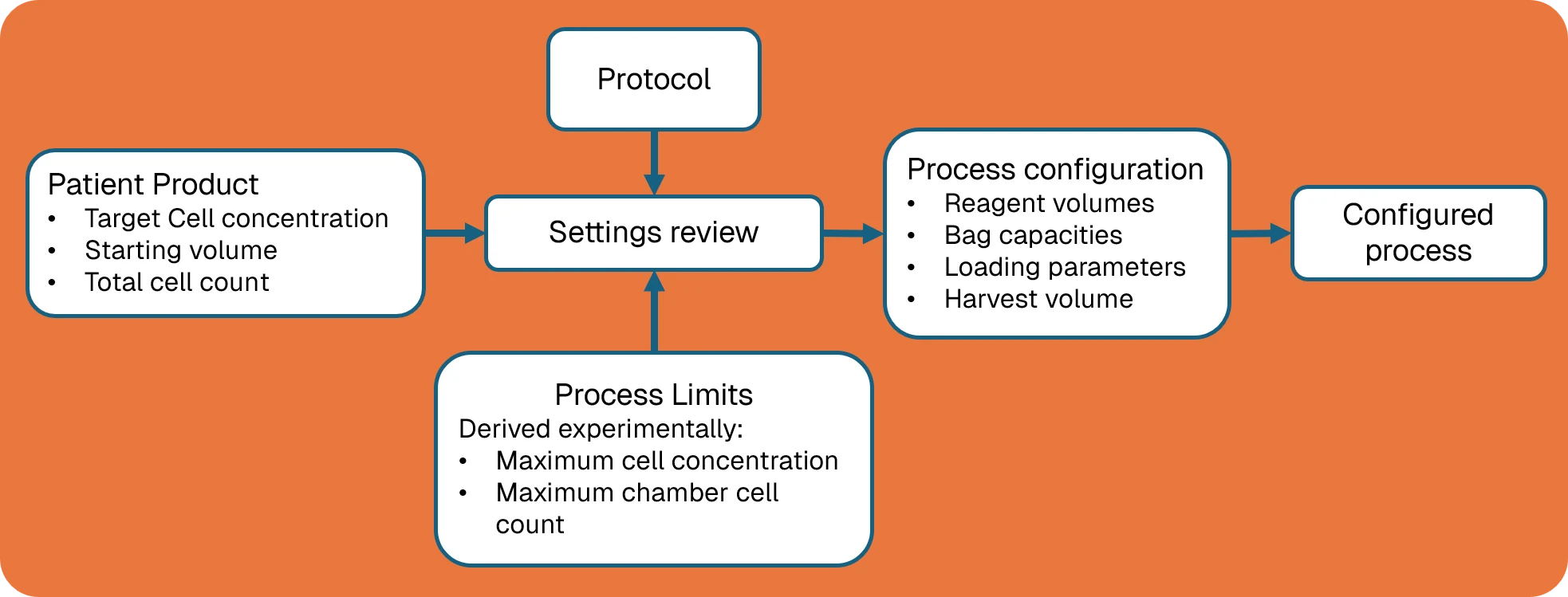
These characteristics influence reagent demand, bag capacities, dilution requirements, loading strategy and recovery settings. Configuring a process therefore becomes a patient-specific engineering exercise rather than simply selecting a protocol.
The Rotea instrument protocol contains the steps of the sequence.
Before each run, someone has to decide:
These decisions are not independent. Changing one parameter can influence reagent demand, bag utilisation, loading behaviour and recovery performance, so the operating conditions need to be selected as part of a complete configuration rather than individual settings.
This article explains how to set the loading volume parameter by way of example and introduces a tool to support process exploration and run time configuration decisions.
Rotea provides tools to handle total cell counts greater than a single chamber load can support.
Looping allows a controlled volume of input product to be processed, returning for another bite until the input is complete.
The process is reliable but conflicted when the last draw down volume is much smaller than the target volume.
For example you have 101 ml of product, and draw down 50ml with each bite.
That last 1ml may not contain enough cells to form a bed, elutriation steps and wash steps are basically disfunctional.
The extra reagent volume consumed by the extra, potentially unexpected step, can lead to reagent exhaustion and process fault.
The real issue is the harvest step, that has very few target cells in it, simply dilutes the output product.
So the starting volume for the input material is important to know when a looping protocol is employed.
The materials are commonly supplied in inside ‘blood transfer style’ bags. Measuring the volume of fluid in the bag is suprisingly unreliable, even when an empty reference bag can be compared.
There are two consequences of poorly known volume. If it is slightly more than predicted, an extra, unwanted loop step may occur. If it is less than predicted, the last loop step may behave poorly, selective elutriation steps are ore coosistemt when the cell count in the chamber is simuialr.
That can be re-phrased as an objective for the last draw down volume. One suggestion is to aim the last draw down volume in the range from 80% and 95% of the target loop draw volume.
so in our example of 101ml of product wth a 50ml draw down volume, we should set the draw down volume to 55ml. Bite 1 = 55ml, Bite 2 = 46ml being 84% of the target.
This logic also tells us how accurate we need to measure the volume: the 80% theeshold is reached if our actual bag volume is 99ml The 95% threshold is reached if the bag volume is 107ml. So in this case we can set the parameter at 55ml as long as the actual bag volume is between 99ml and 107ml, or 12% precision.
Cell concentration influences two separate limits.
First, the concentration of cells entering the chamber can become too high for stable bed formation.
Second, the total number of cells processed during a loading step can exceed the chamber’s practical capacity.
These limits are empirical and depend on cell type, media, centrifuge settings and process objectives.
Why not use many small volume bites?
Specifying a small volume for each bite reduces the cell count per load cycle.
If we decided to use 10ml draw down steps for our 101ml of product to deliver 10 loops, the recommended parameter setting would be 10.2ml, so the volume measurement precison needed is between 102 ml and 99.9ml or 2%.
Decide if dilution is required. If the incoming cell concentraiton is greater than the empirically determined ‘overwhelming’ or maximum loading cell concentration, then set a dilution volume to change the processed cell concentration.
Choose bite volume from cell concentraiton and chamber capacity The incoming cell concentration can then be used against an emprical maximum loading cell count to determine a target maximum paramter setting.
Set bite size so final bite volume around 85%
Verify reagent volumes and bag capacities
Process configuration is often iterative. Adjusting one parameter changes reagent demand, bag utilisation and loading behaviour until a practical operating point is found.
The Volume Init tools within the Rotea Protocol Review application automate much of this reasoning. (Ref 1) Starting from the patient product, they estimate reagent demand, predict bag utilisation, evaluate loading parameters and recommend operating conditions before the protocol is simulated. Rather than relying on trial and error, the application helps identify practical parameter combinations that remain within validated operating limits.
Rather than using Volume Init only to configure an individual manufacturing run, the same tools can be used to explore how a protocol responds to patient variability.
By deliberately varying collection volume, cell concentration and protocol settings, it becomes possible to identify where the process begins to fail or becomes inefficient.
This helps answer practical questions such as:
This approach allows process limits to be understood before manufacture begins. Rather than reacting to unexpected patient products during production, developers can anticipate these situations to design protocols and kit configurations with appropriate operating margins.
Patient variability is one of the defining characteristics of cell therapy manufacture. Unlike conventional pharmaceutical production, the starting material cannot be assumed to have a standard volume, concentration or cell composition.
Successful process design therefore requires more than selecting an instrument protocol. It requires configuration of each manufacturing run so that reagent volumes, container capacities and operating parameters will deliver a robust outcome for that patient product.
The same analysis can also be applied during process development to understand how a protocol will respond to potential variation in patient material. By identifying the operating envelope before manufacture begins, process developers can reduce run-time surprises and deliver manufacturing systems that are more reliable in routine clinical use.
Explore your protocols using the free trial software
Related reading
Building robust processes
We've sent a 6-digit verification code to your email. Please enter it below.