Manufacturing Architecture
Facility and workflow strategies for scalable manufacture.

Workflow Concepts
Using visual management to reduce processing risk
Home > Process Integrity > Tube Tags – A Thought Experiment in Visual Management
20 May 2026 · 3 min read · RoteaHub Editorial
Related topics
Single-use kits may contain many similar tubes and connectors. During kit assembly and processing, operators repeatedly identify, manipulate and connect tubing associated with different reagents and patient products. Every identification step represents an opportunity for human error.
Rather than relying entirely on printed labels and barcode scans, consider adding a simple physical layer of visual management.
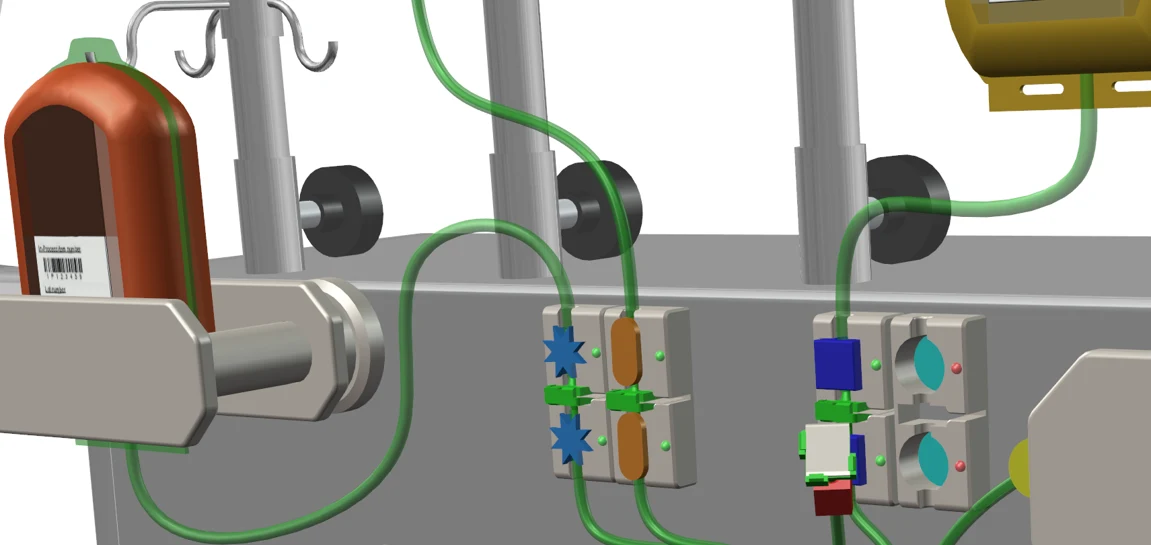
A family of moulded tube tags provides both colour and shape identification. Ten unique tag designs can be sufficient for an entire manufacturing workflow. Shape provides tactile identification and remains distinguishable for operators with colour vision deficiencies, while colour improves rapid visual recognition.
The shapes are designed to slide over the tubes, gripping sufficiently to retain position and not slide off. Local deformation of the tube can systematically open pinched sterile welds as the tag slides over it.
Staging of reagents and patient materials includes the attachment of the tags to each of the bags. The tag becomes part of the chain of custody, accompanying the material from staging through processing and ultimately to disposal.
The identification therefore accompanies the assembled kit throughout the manufacturing process, reducing the need to repeatedly interpret printed labels during operator interactions.
The concept becomes particularly valuable at high-risk operations such as sterile welding, where the presented tube pair can be verified before the weld cycle is initiated.
A removable guide fitted to the sterile welder presents the expected tube tags.
Each guide plate is uniquely identified and associated with a specific process step. The MES verifies that the correct guide is in place.
Simple sensors confirm that the expected tube tags have been presented before the welding cycle is enabled.
The simplest implementation provides only visual confirmation. Verification modules can then be added to confirm the correct presentation of tube tags, while embedded RFID or similar technologies could ultimately replace barcode scanning without changing the operator workflow.
A simple label mounted on the kit frame could associate each tag shape with its corresponding bag location. During kit installation, the same tag set could then be verified before processing begins.
The same physical tags could ultimately integrate additional functions, such as automated tube clamping commanded by the MES during setup, or electronic identification, while preserving the same operator workflow.
Tube tagging can address several common manufacturing hazards, including incorrect reagent selection, incorrect patient product connection, sterile welding of the wrong tubing, and omission of verification steps. Rather than relying solely on procedural compliance, a workstation can actively guide the operator toward the intended action.
The approach also standardises operator interactions, making procedures easier to learn, easier to audit and more consistent between manufacturing sites.
Tube tags are a simple example of a wider principle. Visual management elements in the process design can guide operators toward the correct action while providing independent opportunities for verification. Visual management becomes another layer of process assurance, complementing procedural controls, electronic records and operator training.
Related reading
Facility and workflow strategies for scalable manufacture.
We've sent a 6-digit verification code to your email. Please enter it below.