FMECA framework workbook
Structured failure mode analysis template for functionally closed process review.

Rotea Process Insights
Process integrity for single use kit assembly
Home > Closed Unit Processes > Kit Assembly Assurance
8 June 2026 · 6 min read · RoteaHub Editorial
Related topics
Identifying and controlling the process hazards associated with single-use kit assembly.
Single use kit assemblies are central to functionally closed manufacture.
The disposable kit forms the patient-contact pathway and therefore becomes part of the manufacturing process itself. Sterility, materials of construction and supply chain controls must all be considered as part of process qualification.
The kit must also support each unit operation within the workflow, including product loading, reagent addition, sampling and transfer to downstream processes.
Kit assembly for functionally closed manufacturing needs to be formalized as part of the overall quality assurance program. This article presents one approach.
An FMECA document was developed to explore the process risks related to operation of a Rotea process.
It was clear that some hazards identified originate from the kit assembly steps.
The FMECA was then expanded to capture kit assembly and the hazards those actions must avoid:
The FMECA document is available for download in the links below.
It is common for functionally closed unit process systems to include a kit specific to the instrument that is adapted for the application by attachment of additional dry components, output culture bags, vent filters, output cryo-storage bags, culture vessels.
If these elements do not contain fluids and are common for every batch of the process, it is reasonable to pre-prepare one or more assemblies before the process is scheduled to begin as a staging procedure.
In a commercial manufacturing situation those pre-assemblies can be completed externally and delivered as a sterile dry kit assembly.
Prior to the batch run, any batch specific requirements - such as a batch specific count of culture bags and any wet reagents need to be prepared for assembly.
Some processes may require pre-staging of high cost reagents such as magnetic beads or viral vector based on projected cell counts. These activities need to be woven into the manufacturing plan to ensure the process is comprehensively functionally closed. Staging through a clean room suite may be practical, but a functionally closed aliquoting station might also be considered.
As the patient materials become available for processing the kit assembly can proceed with attachment of all fluid containing elements.
The final assembly step should be attachment of the patient material to minimise its exposure to other assembly hazards. The process design needs to decide if this is a separate batch procedure or just part of preceding actions.
Sterile welding using a Terumo TSCD welder (by way of example,) is a robust, validated process. Sterile tube welders are qualified as medical devices when the tubing being joined meets the specified requirements - material and geometry.
Problems with sterile welding occur when the tubing is not well presented to the weld process, or is under tension.
When assembling a multi-bag sterile kit where one or more bags have fluid in them, handling the many moving elements
and presenting them to the welder can become physically challenging.
It is not uncommon to observe two people wrestling the kit elements through the welding steps.
It is vital that the tubes for welding are well presented to the welder process.
In the case of a Rotea kit assembly, (as an example,) it is also important that the length of the tubing between the kit elements and the attached bags are within a nominal setting.
Consideration of tube presentation to the welder also needs to make provision for disconnection and re-connection of kit elements if required.
An assembly aid to address these requirements should be considered.
Traceability of all materials is an essential part of manufacture. Barcode-based identification is widely used to link disposable kits, reagents, samples and patient materials to the batch record. Assembly activities should preserve this traceability throughout the process.
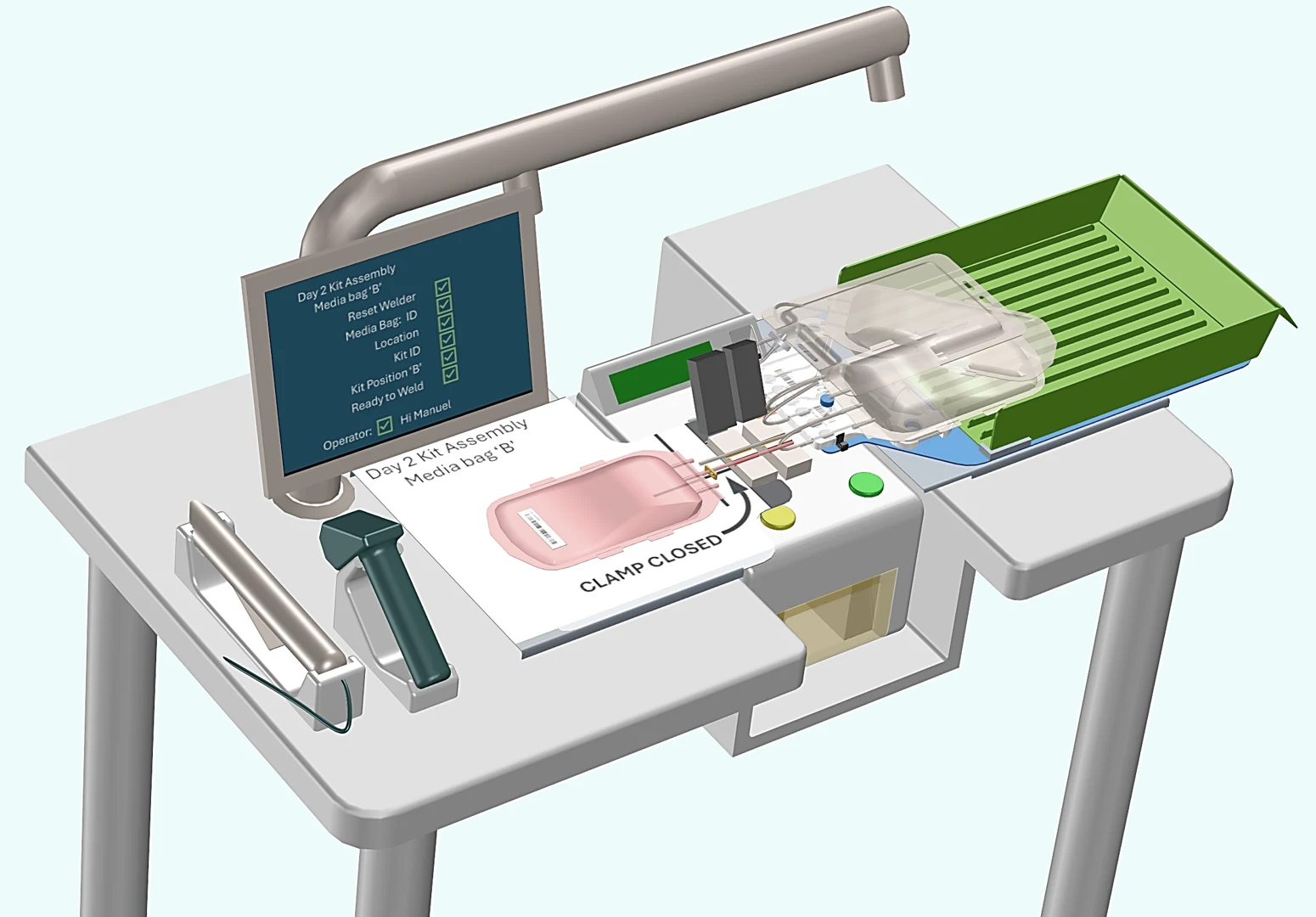
A kit assembly station is illustrated. It is configured for Rotea kits and supports an operator assembling the ‘Day 2’ kit.
The unit process single use kit is scanned to verify the correct kit has been selected and capture the ID in the MES. All components are verified by barcode as they are introduced and placed by the operator.
The workstation provides visual prompts for the operator to position the fixture holding the kit and the bag to be attached.
The bag presentation side and the kit fixture side are configured to create the best conditions for welder function.
The station verifies that the correct bag, kit position and placement have been achieved before the sterile welder can be initiated.
The workstation is integrated to the MES recording the data and sequence as it unfolds.
Incorrect clamp placement or clamp status may lead to process failure, unintended fluid transfer or loss of product. Automated verification of clamp location and state may therefore provide a significant reduction in assembly risk.
The assembly station described in this article presents a design concept conceived to mitigate the hazards identified in kit assembly operations.
This concept remains under evaluation and has not yet been implemented.
Single-use kit assembly introduces a range of process hazards that can directly affect manufacturing outcomes. While sterile welding technologies and barcode-based traceability systems are well established, their effective application depends on a structured assembly process.
By treating kit assembly as a formal manufacturing activity, organisations can apply hazard analysis, workflow controls and traceability measures to reduce risk and improve process reliability.
The assembly station concept described here illustrates one approach to integrating those controls into a practical operator workflow.
Downloads
Structured failure mode analysis template for functionally closed process review.
We've sent a 6-digit verification code to your email. Please enter it below.