
FMECA framework workbook
Structured failure mode analysis template for functionally closed process review.

QA / Risk Analysis
Home > Closed Unit Processes > Functionally closed sampling for QC
9 June 2026 · 6 min read · RoteaHub Editorial
Related topics
In-process QC sampling is a critical control point in functionally closed manufacture. A closed process does not, by itself, assure sample integrity. The sample must be representative, traceable, and isolated from the processing environment.
Live cell-derived therapeutic products depend on QC measurements and the decisions those measurements direct.
Whether the measurement is cell count, viability, phenotype, or potency, the most important question is whether the sample represents the product being tested. Cell suspensions can settle rapidly. Within minutes, large cells, small cells and aggregates are not evenly distributed.
Open process techniques often rely on manual resuspension before a sample is withdrawn. In a functionally closed process, that challenge must be addressed deliberately. If the product is contained in a bag, bottle, or rigid culture vessel, the sampling method must create a homogeneous suspension and access that suspension without exposing the process to the environment.
It is concerning to see process methods that instruct the operator to “mix the bag” before sampling, without defining how mixing is to be achieved or verified. One operator may massage the bag. Another may rock it. Another may shake it more vigorously. All may be trying to do the right thing, but each introduces a different sampling condition.
Humans are highly motivated to perform well, but manual bag mixing is not a controlled unit operation. Different people mix differently, and even the same person may mix differently over time.
To sample from a bag or closed container, the process must first create a homogeneous cell suspension and then draw the sample from that suspension.
The goal is to translate mixing from an operator-dependent action to a defined and verifiable mechanical operation.
Experience has shown that bag rocking systems can fail to create a homogeneous cell suspension if the rocking action does not vigorously ‘slosh’ the product in the bag.
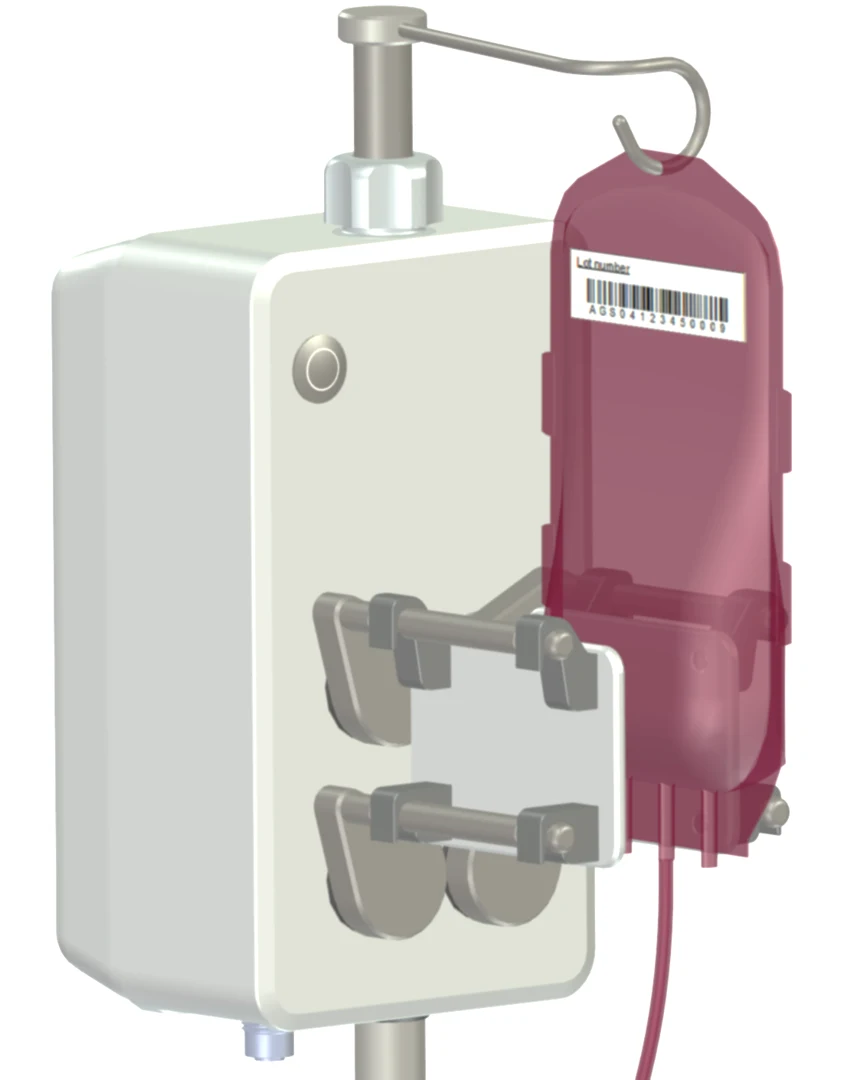
An alternative proven approach is to suspend the bag and create a controlled swirling motion using a paddle mixer.
Rigid containers such as T-flasks, cell cubes and G-Rex culture vessels need specific handling to create the suspension. A verifiable method is recommended regardless.
Good mixing ensures the suspension is representative. Accessing that suspension is a separate problem.
Drawing a small sample directly from the tubing attached to a bag may simply recover the residual fluid sitting in the line, not the mixed contents of the bag. A representative sample must come from inside the mixed volume, not from the stagnant connection tube.
One manual workaround is to use a larger syringe to draw and return fluid several times before retaining the required small sample.
A more controlled closed-process approach is to create a recirculation loop between two ports in the bag and pump the bag contents through that loop. The sample can then be diverted from a moving, mixed stream.
Once a representative suspension is present in a recirculation loop, the target sample volume can be redirected to a sample vessel.
To preserve the benefits of functionally closed manufacture, the sample vessel must remain isolated from the processing environment.
The QC laboratory may subsequently open and test the sample, but that open activity must remain separated from the manufacturing environment. Formal pass-through to the QC laboratory for management of environmental controls is essential.
The sample vessel may be a small bag, vial, or a sealed length of tubing used as a sample straw. Product loss should be minimized. For non-proliferating cells such as monocytes for example, an aggressive sampling plan can consume a substantial fraction of the available starting population.
One way to reduce sampling loss is to use an air chaser.
In small-diameter tubing, surface tension will robustly hold a small liquid slug in place.
A defined volume, for example 0.2 mL, can be delivered into the tubing and then chased with air so the sample reaches the target straw segment.
The sample straw can then be sterile-sealed and cut for transfer to QC.
Dedicated sample lines can be terminated with a sterile vent filter, allowing air displacement during filling while maintaining environmental isolation.
Straw sampling is a proven concept in blood banking. Dedicated straw-stripper tools are used to recover the sample after the straw is opened.
Where multiple small samples are required, a longer straw can be segmented using air gaps between each controlled volume sample.
For larger sample volumes, or to support an extensive QC panel, a small bag is simpler, with air used to chase the selected sample volume through the connecting tube.
When a cell suspension passes through a dry tube, a small volume of fluid is retained on the tube wall as the surface becomes wetted. The magnitude of this effect depends on factors including fluid osmolality, surface chemistry and the material properties of the tubing.
This raises the question of whether the resulting sample remains fully representative of the source material. Could selective retention of particular cell types on newly wetted surfaces alter the composition of the sample presented to QC?
Informal studies and operational experience have not shown evidence of systematic cell-type bias arising from this effect.
At larger scales, such as the internal surfaces of bags, testing has demonstrated a consistent hold-up volume for a given combination of materials and fluid. Interestingly, flushing such a bag with additional media retrieves cells residing within that retained volume in a manner broadly consistent with the dilution introduced by the rinse.
These observations suggest that cells associated with non-adherent surface wetting volumes are not necessarily lost permanently and may remain accessible through appropriate rinse or recovery strategies.
While dry-surface wetting effects should be considered when designing sampling workflows, current observations suggest they are unlikely to materially compromise sample validity for typical cell-processing applications.
Transferring samples from the process into the QC environment is a critical chain of custody hazard.
The batch identity and sample ID associated with the batch must travel with the sample to QC. QC must associate the measurements back to batch; in some cases to direct the next batch actions, such as a cell count directing the number of doses to be dispensed.
A common approach is to print batch-specific labels for attachment to process outputs, including QC samples. This introduces its own management burden, requiring careful control and reconciliation of printed labels. An alternative approach is to assign unique identifiers to all kit elements that may become separated from the process and allow the MES to manage the resulting relationships. However, complete reliance on MES-managed identification creates a potential single point of failure, leading many organisations to retain independent verification methods.
It is sufficient to highlight that sampling design needs to include this critical process integrity consideration.
The creation and management of in-process samples is a critical component of live cell manufacturing. The detailed implementation is influenced by many factors, including the source vessel, sample volume requirements, environmental controls, and downstream analytical methods.
Functionally closed manufacturing requires these sampling methods to be formalised as controlled unit processes rather than operator-defined activities.
The manufacturing system design for sample capture and isolation should be designed around existing tools for the purpose, or tools should be designed for it.
One example of a tool designed to realise these actions as a closed unit-process is the Thermo Fisher Scientific Gibco CTS Compleo instrument, which combines controlled mixing, recirculation and sampling to support fill-finish operations.
Closed sampling demonstrates how process integrity requirements can influence manufacturing system design. The combination of mixing, sample extraction, isolation and traceability lends itself naturally to dedicated process equipment and workstation-based implementation.
Downloads
Structured failure mode analysis template for functionally closed process review.
We've sent a 6-digit verification code to your email. Please enter it below.